Categories
Uncategorized

Case Study Analysis

Introduction to the different conflict handling style

When there are conflicts, there are ways to dissolve the conflict. The five major types of conflict management styles are avoiding/withdrawing, accommodating, collaborating, competing and compromising.
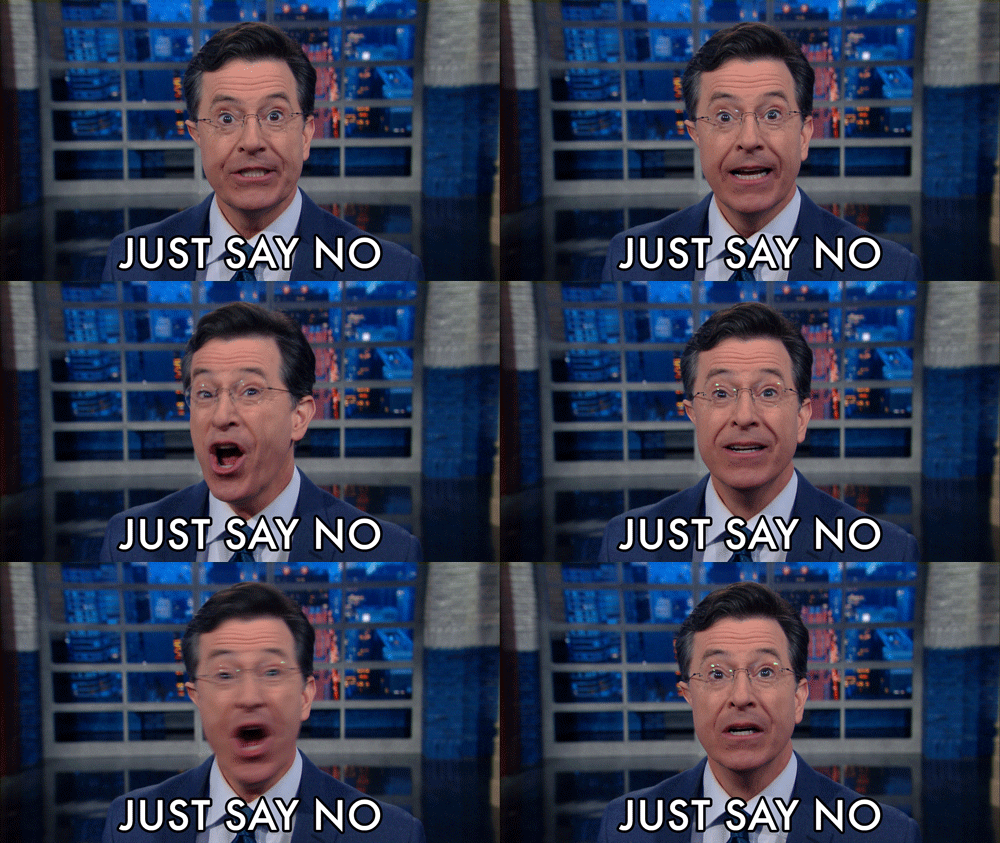
For avoiding/withdrawing style, the person will tend retract their point of view and not pursue their beliefs. They would either continuously postpone or completely dodge the conflict whenever it arises. This will in turn cause a lose-lose situation as both party will not be able to find a proper solution to the problem.
Image Source

Accommodating style is where one party will forsakes their own needs or desire in exchange for others. They will give in to the conflict and cause themselves to be in a disadvantage situation. This will result in a win-lose situation.Accommodating style is where one party will forsakes their own needs or desire in exchange for others. They will give in to the conflict and cause themselves to be in a disadvantage situation. This will result in a win-lose situation.
Image Source

As for collaborating style, both party in the conflict will try to find a solution where it will meet the needs of all parties. As having two parties of different background working together to find a satisfactory solution, it may take up a considerable amount of time for them to resolve the conflict. With skills and time, this style will result in a win-win situation.
Image Source

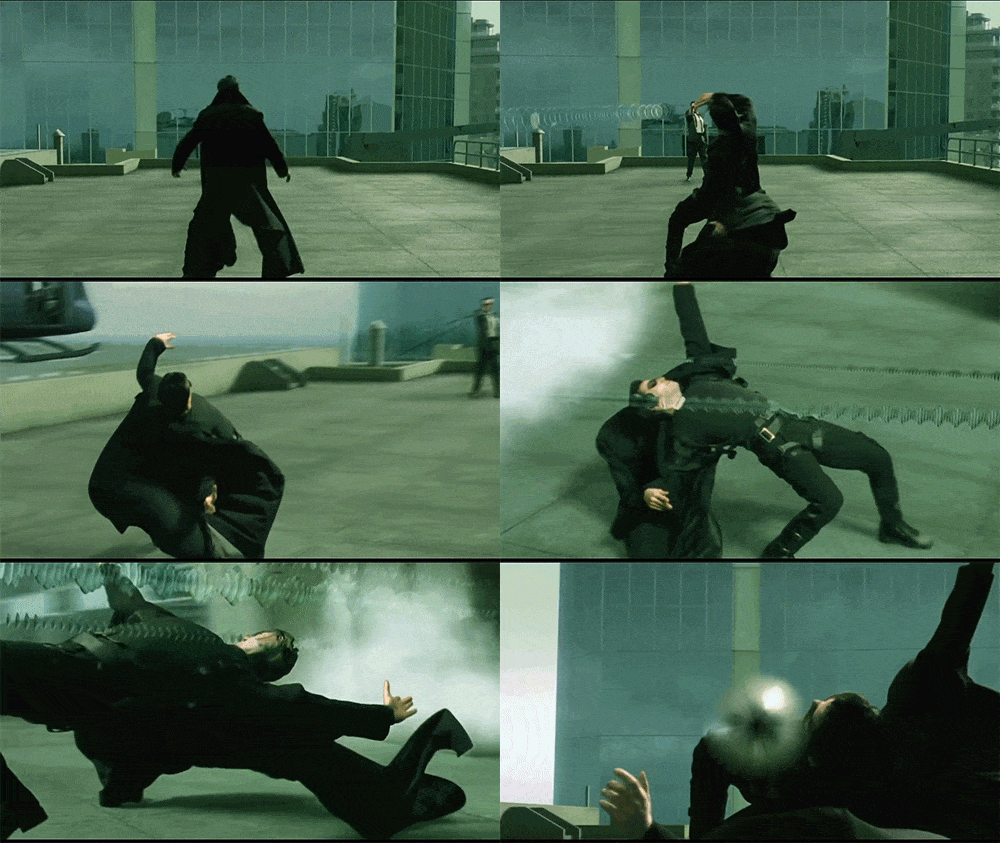
However the competing style is when one of the party tries to gain the most advantage of the opposite party. They will take a firm stance and negotiate to maximize its result ignoring the other party’s perspectives. This style is useful if you have to stand up for your rights or to prevent a terrible decision from being made. Therefore this conflict management style will likely end in a win-lose situation.
Image Source

Lastly for compromising style, there will be an attempt to find a way to please all parties in the conflict. People will have to find a middle ground where all needs are met. This will led to people being satisfied or unsatisfied to a certain extend. Therefore the result of this style can either be win-lose or lose-win or win-win depending on the situation.
Image Source

The Scenario

Robert, a director and union member, has requested an 8 percent raise for his work unit. His request is based on recent finance reports showing that his department has substantially contributed to a 15 percent profit increase for the organisation. He feels that his team should be compensated for the hard work and long hours they have put in over the last few years to achieve this outcome. Kay knows the value of Robert’s team and readily acknowledges their achievements. However, she knows that the company has plans to expand and diversify. This new project will use up the majority of the profit increase for at least the next five years. She is willing to sit down with Robert and talk about how his team can get involved in the new project. There could be new job opportunities, some overseas assignments, and possible promotions to various leadership positions within the new project. Kay has flagged this with Robert; however, he is adamant that his team needs to be compensated with a monetary increase. He went as far as threatening to get the union involved if his request is unsuccessful.

Identify one of the conflict handling style used in this scenario

After analyzing the scenario given, I have identified the competing style as one of the conflict management style used. From the scenario, despite Kay mentioning to Robert on how they could involve Robert’s team on the new project where there are attractive incentives. Robert is still adamant that his team needs to be compensated with a monetary increase. Robert also mentioned that he would get the union involved. This shows that Robert is taking a firm stance and unwilling to back down on this situation. Robert is using this conflict management style to stand for his rights.

Bargaining Approach by Robert

From the given scenario, we can tell that the bargaining approach used by Robert is the distributive approach. As Robert is adamant that his team needs to be compensated with monetary increase, this shows that he is trying to gain the maximum value for themselves. With Robert being unwilling to back down from his demands, it will lead to a win-lose situation. Therefore, Robert is using the distributive bargaining approach.

What aspect of interpersonal communication is contributing to the poor working environment?
In the non-verbal aspect of interpersonal communication, listening is one of the most important element. By listening to the opposing party, we will be able to determine the best way to resolve the problem being faced. It also helps us to build a better relationship with one another and also lead to compromising or collaboration in negotiation. In this case, Robert lacks in listening skill as he refuses to listen to Kay’s suggestion. On the other hand, Kay did listen to Robert as she acknowledges the hard work being put in by him and his team. She provided Robert with a suggestion that comes with attractive incentives but she did not compromise to meet Robert’s demand.

Hall’s context model

Using the Hall’s context model, it can be derived that Robert is a low context person. The way he conveyed his demands to Kay are simple and clear. From the way he talk to Kay, it can be seen that Robert thinks that product is more important than the process. He wants his demands being met without thinking of a process where he can get his demands without having anyone lose out in the negotiation.

Conclusion
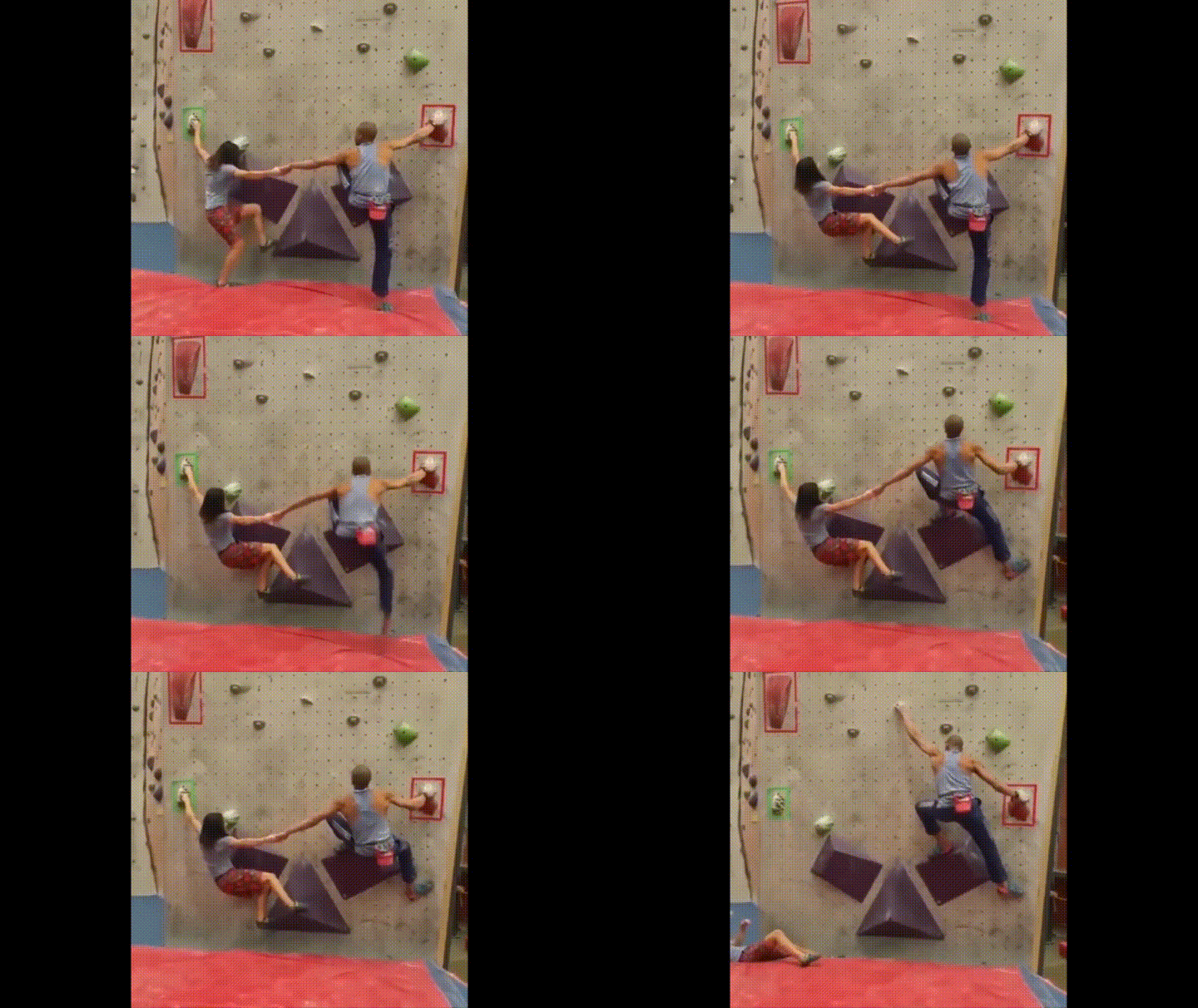
Don’t be like this.
Image Source

In conclusion, Robert should have back down and discuss what Kay have suggested to him with his team to find out what everyone truly wants. Both Kay and Robert should have discuss and try to collaborate with each other. By collaborating, they will be able to achieve a win-win situation which results in both party getting what they want. Therefore, this case study have taught us how important it is to listen to the demands of the other party and try to collaborate with each other. Although it can be a long process, it will eventually lead to a pleasant result for everyone. Thanks for reading. Peace 🙂

References

Amaresan, S. (2020). 5 Conflict Management Styles for Every Personality Type. [online] Blog.hubspot.com. Available at: https://blog.hubspot.com/service/conflict-management-styles [Accessed 2 Feb. 2020].
Categories
Uncategorized

Stereotypes

Introducing you to stereotyping

Stereotype is a set idea that people have about what someone or something is like, especially when the idea is wrong. Stereotypes are often confused with prejudices as both are based on prior assumption. Stereotypes are often created about people of specific cultures, races or religion. For example, some people says that all Muslims are terrorist (Just an example. I apologize if I happen to offend anyone.). That is stereotype as the idea is wrong. Gender stereotypes and sexual orientation stereotypes also exist. An example of gender stereotype is when you say that female drivers are bad drivers, you are stereotyping females. As for sexual orientation stereotype, it occurs when you have negative views on gays, lesbians and transgender individuals.

Why is it bad to stereotype?

Stereotyping can lead us to become bias towards an individual. Even though in some cases where the stereotype is correct, constantly putting someone down based on your preconceived perceptions will not encourage the individual to succeed. Stereotyping can lead bullying as well as people living their lives driven by hatred or fear. For example, many gays and lesbians are afraid to admit their sexuality in fear of being judged by others. Victims of the stereotypes are often hurt by those who are doing the stereotyping. Therefore stereotyping is bad for both the victims and those who are doing it.

How does stereotyping affect the way we communicate with each other?

When we start stereotyping, we tend to judge others based on false information or assumptions which can easily cause misunderstanding. Conflict may also arise because of that. For example, Chinese eat things that are exotic. This stereotype have blown up due to the recent coronavirus (Wuhan Virus). Due to this, if we were to travel to the western countries telling them that we are Chinese, they may give us the dirty look. Even though we do not eat any exotic food in Singapore. Some people may even think that we have the virus and want us to get out of their country. This can restrict us from being able to communicate effectively with them as they would want to stay away from us.  

Past Experience

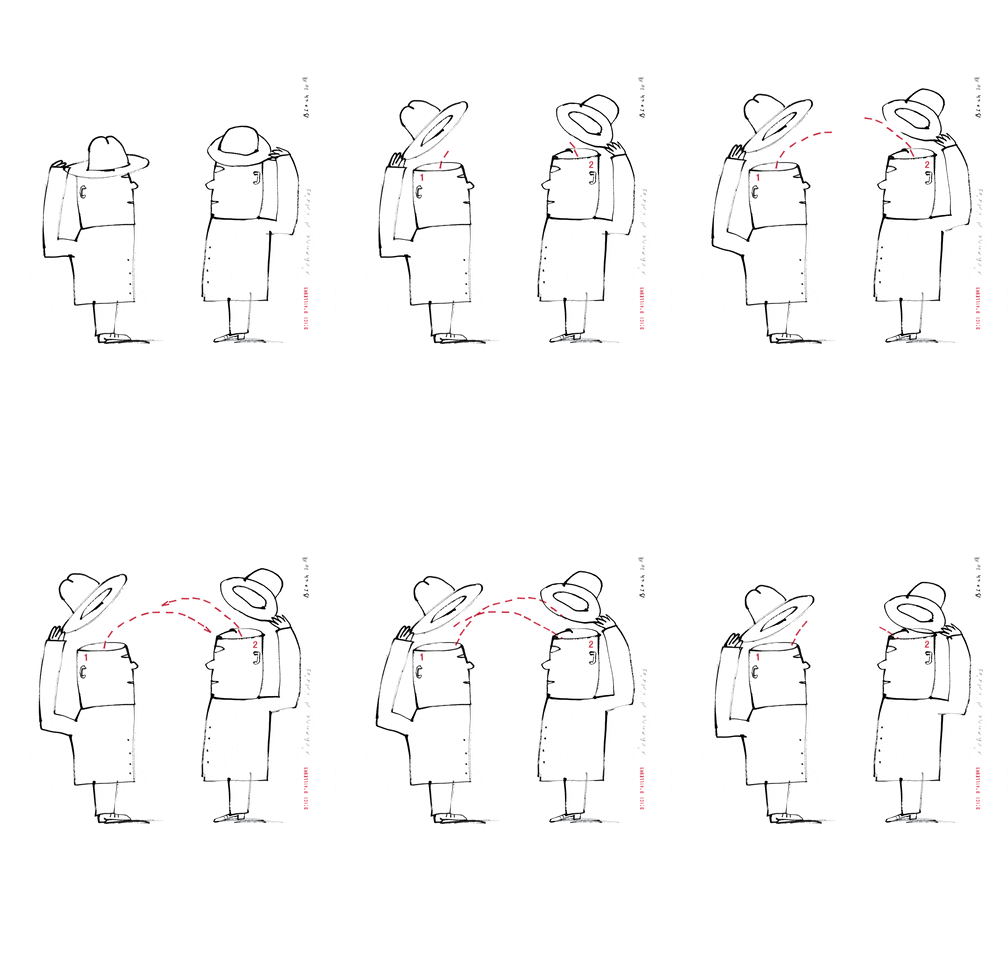
Storyboard for my past experience.

One of my past experience is from my time in the National Service (NS). This happen between my friends while we were having our lunch break. Friend A which is an Indian asked friend B which is a Chinese what he wants to eat for lunch. While deciding what to eat at the canteen, friend B smelled something unpleasant and asked friend A about it. As both were clueless of where the smell originate from, friend B jokingly said that the smell was from friend A because Indians always never bathe. The stereotyping happened between two friends that were quite close to each other. So no one really got offended by it and they just laughed it off. If it were to happen to someone else that are not close to each other, conflict is bound to happen.

What are the implications of such event occurring in your social life?

Even though this incident is just a joke in between friends, it could have turned out in a different way. As the comment made by friend B is quite racist, he could have offended friend A which would result in a conflict between the two of them. Or even those people that are nearby that overheard their conversation. In conclusion, stereotyping is a double edge sword. Sometimes it may not hurt the one doing it but it will definitely hurt the other party or those that are nearby. No matter the circumstances, we should avoid stereotyping as much as possible. So before we stereotype someone, we should look at ourselves and then put ourselves into their shoes and think of how they will feel. Say no to stereotype. Peace 🙂

References

YourDictionary. (2020). Stereotype Examples. [online] Available at: https://examples.yourdictionary.com/stereotype-examples.html [Accessed 31 Jan. 2020].

Categories
Uncategorized

Johari Window

Introduction to Johari Window

Johari Window
image source : https://medium.com/@muabusalah/johari-window-technique-can-improve-the-culture-of-knowledge-sharing-f9c853a549e4

The johari window was developed by two American psychologists Joseph Luft and Harry Ingham in 1955. The Johari window model is based on two ideas – trust can be acquired by revealing information about you to others and learning yourself from their feedback. Joseph Luft then improved the model later on. When individuals are in a group, it is necessary for them to improve on self-awareness and personal development. With this model, it can provide us with a convenient method to better understand and enhance communication between group members. Therefore, this model is also denoted as feedback or disclosure model of self-awareness.

The four components of Johari Window

Johari Window to show the four components
Image source : https://www.communicationtheory.org/the-johari-window-model/

Let us talk about the open area first. The area in the top left corner of table shows us the information about the person’s attitudes, behaviour, emotions, feelings, skills and views. This information is known by the person himself and also by others. Secondly, blind spot contains information about yourself that are unknown to you but not to others. As they may interpret you differently from what you expect of yourself. Followed by façade, it contains information that are known to you and not to others. It may be any personal information which you feel reluctant to reveal to the public. The information may include feelings, past experiences or even fears. Lastly, the unknown area contains information that are unaware to you as well as others. The information here maybe caused by traumatic past experiences or events which can be unknown for a lifetime.

My Johari Window

^ This is the analysis done by Wilson Tay.
^ This is the analysis done by Sol Kwon.

An accurate presentation of myself?

The analysis using the Johari window model was done by my friends which I just met. I have known Wilson and Sol for only 6 months in SIM-UOW. From their analysis, I have found out many things that I did not know about myself. For example, both of them thinks that I am confident but actually I constantly doubt myself whenever I do something. Although we do not spend much time outside of school together, I found out that about 60% of the analysis are the same. However, I would say that the results from the models are only accurate to a certain extent. As there are many different things that will affect the results of the model. For example, we as humans, we tends to act differently in different places or with different people. For one to truly know someone, they will have to be part of their daily life. Only then, we can truly determine how that person behaves in different locations and how they are when around different people. Therefore, I think that the analysis from the both of them is only be half accurate.

Surprised or meh?

After going through the analysis, I am surprised to find out that both of them thinks that I am intelligent and knowledgeable despite my exam result is just average. Perhaps this is because I was able to answer some of their questions whenever they face difficulty when doing some of our assignments. I am also surprised that none of them thinks that I am shy and introverted. Most of the time I have difficulty initiating conversation with a stranger and if it is not necessary I would rather stay at home than going out.

Conclusion

Thus this result will be useful for self-awareness and your communication in the team because it allows us to know ourselves and our group members better. It can help us know what our flaws are so that we are able to change for the better. “Perfection is achieved not when there is nothing more to add, but rather when there is nothing more to take away.” Therefore, by removing the flaws that are identified by others, we can better improve ourselves. Hence, this result is useful for self-awareness and our communication in the team. Thanks for reading. Peace 🙂

REferences

Communication Theory. (2020). The Johari Window Model. [online] Available at: https://www.communicationtheory.org/the-johari-window-model/ [Accessed 24 Jan. 2020].

Medium. (2020). Johari Window Technique Can Improve the Culture of Knowledge Sharing. [online] Available at: https://medium.com/@muabusalah/johari-window-technique-can-improve-the-culture-of-knowledge-sharing-f9c853a549e4 [Accessed 24 Jan. 2020].

Categories
Uncategorized

Is Shannon and Weaver’s (1954) model of communication complete?

Introduction to communication

The communication process
image source : http://ioc.edu.my/images/demo/printedMaterial/OUMH1203.pdf

Communication has been defined as the act of transferring or receiving information, ideas and opinions between two or more parties. The several important elements in the communication process are sender, message, channel, receiver, feedback and context. The communication process can be seen from the picture above. A sender will speak or send a message with a certain intention and a receiver will receive and tries to understand the message. The receiver will then give a feedback back to the original sender who will then interprets the feedback. This cycle will repeats continuously and thus, this is basically what communication is.

Shannon and Weaver’s Communication Model

Shannon and Weaver’s communication model
image source : https://www.communicationtheory.org/shannon-and-weaver-model-of-communication/

The Shannon and Weaver’s communication model is created in 1949 by Claude Elwood Shannon who was an American mathematician and Warren Weaver who was an American scientist. The communication model was developed to establish an effective communication between the sender and receiver. The first version of the model only consist of five elements: an information source (sender), which will produce a message; a transmitter (encoder), which will encode the message into signals; a channel (e.g. cables or satellites), which will transmit the signals; a receiver (decoder), which will decode or reconstruct the signals back into message; a destination (receiver), where the message will arrive. A sixth element, noise (e.g. static or crackling from wires) was added onto the model later on, it will cause interference with the message travelling along the channel. The final version of the model had 7 elements with the feedback loop being added into the model as the seventh element.

Is the model of communication complete?

Even with the feedback loop being added to the model, the feedback is too vague. As I have mentioned above, context is one of the important elements in the communication process. The feedback from the receiver can be replied using context such as non-verbal communications, relationship between the sender and receiver, timing and the intentions of both sender and receiver. The Shannon and Weaver’s model of communication is more effective in person to person communication rather than group or mass audience. Therefore, it is hard to apply this model into all the different kind of communication that exist today.

Conclusion

Dwyer’s communication model

In conclusion, the model has inspired many communication researches but it still have areas that could be improved on. The Dwyer’s model includes the perception of the sender and receiver. Therefore, I feel that it is a better representation for communication instead of the Shannon and Weaver’s communication model. Thanks for reading. Peace 🙂

References

http://ioc.edu.my/images/demo/printedMaterial/OUMH1203.pdf

https://www.oxfordreference.com/view/10.1093/oi/authority.20110803100459436

Shannon and Weaver Model of Communication

Design a site like this with WordPress.com
Get started